

Quick answer: If one bulb flickers, it’s usually the bulb or an LED that doesn’t match its dimmer. If one room flickers, look for a loose connection at a switch, outlet, or fixture. If lights across the whole house flicker, or some get brighter while others dim, suspect a loose neutral at the meter or panel. That one needs an electrician the same day.
Key takeaways
- Where the flicker happens tells you more than anything else: one bulb, one room, or the whole house.
- A quick dip when the air conditioner, fridge, or well pump starts is normal. A dip that lasts, or gets worse, is not.
- Bulbs are the only cause a homeowner should fix. Everything else is behind a switch plate, in the panel or at the meter.
- Some lights brightening while others dim is the classic sign of a loose neutral. It can damage electronics, so call right away.
- In Iowa, MidAmerican Energy or Alliant Energy owns the overhead line and the meter. The weatherhead, mast, meter box and everything inside your home are yours to maintain.
Step 1: Work out where the flicker is happening
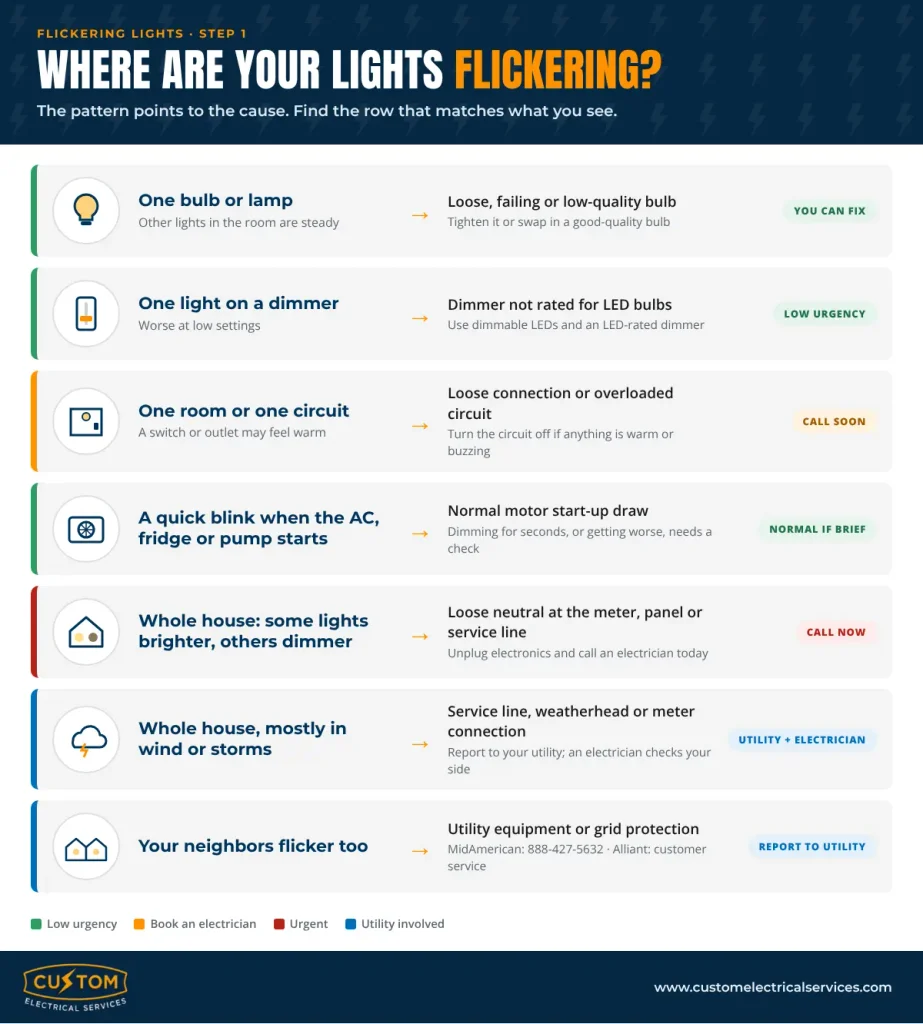
Before you change anything, spend a day noticing the pattern. Electricians ask these questions first, because the answer narrows nine possible causes down to one or two.
| What you see | Most likely cause | How urgent |
|---|---|---|
| One bulb or one lamp | Loose, failing or low-quality bulb | Low: try a new bulb |
| One fixture on a dimmer, worse at low settings | Dimmer not rated for LED bulbs | Low: replace the dimmer |
| One room, or the lights on one circuit | Loose connection at a switch, outlet or fixture; overloaded circuit | Book an electrician soon |
| Lights dip for a moment when a big appliance starts | Normal motor start-up draw | Normal if it’s brief |
| Lights dim for several seconds, or flicker every time the AC runs | Undersized or overloaded service, loose connection, failing AC part | Book an electrician |
| Whole house, with some lights brighter and others dimmer | Loose or broken neutral at the meter, panel or service line | Call now |
| Whole house, mostly in wind or storms | Damaged service line, weatherhead or meter connection | Call your utility, then an electrician |
| Several neighbors flicker too | Utility equipment or grid protection | Report it to your utility |
The 9 causes of flickering lights, from harmless to urgent
1. A loose or failing bulb
What’s happening: A bulb that isn’t screwed in fully makes intermittent contact, so footsteps, a slammed door or the furnace fan can make it flicker. Cheap LED bulbs can also flicker on their own because of poor internal drivers, the small electronics that turn household power into the low voltage the LED chips use.
What to do: Switch the light off, let the bulb cool, and tighten it. If it still flickers, swap in a good-quality bulb of the type the fixture calls for. If a brand-new bulb flickers too, the problem is in the socket, switch or wiring.
Who fixes it: You.
2. LED bulbs on a dimmer that wasn’t made for them
What’s happening: Most older dimmers were built for incandescent bulbs. They work by chopping the front of each AC wave (“leading-edge” dimming), and they expect the steady load of a hot filament. An LED draws a tiny fraction of that, so the dimmer can’t regulate it smoothly. The result is flicker, strobing, or a low buzz, usually worst near the bottom of the dimmer’s range. Smart switches that don’t use a neutral wire can cause the same thing, because they leak a little current through the bulb to power themselves.
What to do: Check the dimmer’s label for “LED” or “CL” rating and use bulbs marked “dimmable”. Most dimmer makers publish lists of bulbs they’ve tested. If the dimmer has a low-end trim adjustment, raising it can stop flicker at the bottom of the range.
Who fixes it: An electrician, to replace the dimmer with an LED-rated or trailing-edge (ELV) model, or to run a neutral to a smart switch.
3. Voltage dips when big appliances start
What’s happening: Motors need a surge of current to get moving. A central air conditioner, heat pump, refrigerator, sump pump, or well pump can briefly draw several times its running current. That pulls the voltage down for everything else on the panel for a fraction of a second, and the lights dip.
| Appliance | Typical start-up draw | Is a brief dip normal? |
|---|---|---|
| Central AC or heat pump | 5–8 times its running current | Yes, under a second |
| Well pump | 4–7 times | Yes, under a second |
| Refrigerator or freezer compressor | 3–6 times | Yes, briefly |
| Washing machine | 2–4 times | Yes |
What to do: If the dip is brief and only happens at start-up, it’s normal. If the lights stay dim for several seconds, the dip is getting deeper, or it started after the AC was replaced, have an electrician check the service size, the connections at the panel and the voltage under load. A failing AC start capacitor can also make the compressor draw more current for longer, so an HVAC check may be needed too.
Who fixes it: An electrician, sometimes with your HVAC contractor.
4. A loose connection at a switch, outlet or fixture
What’s happening: Connections loosen over years of heating and cooling, vibration, or because they were made poorly in the first place. “Backstab” outlets, where the wire is pushed into a hole on the back instead of wrapped around a screw, are a common culprit. A loose connection has extra resistance, so it heats up and makes intermittent contact. Loose connections are a leading cause of electrical fires.
Signs:
- Flicker limited to one room or one fixture
- Flicker that changes when you wiggle the switch or tap the wall plate
- A switch, outlet or dimmer that feels warm
- Buzzing, crackling, scorch marks or a burning smell
What to do: Turn off the breaker for that circuit and call an electrician. Don’t keep using a switch or outlet that’s warm or discolored.
Who fixes it: An electrician.
5. An overloaded circuit
What’s happening: Most lighting and outlet circuits are 15 or 20 amps. When a space heater, hair dryer, vacuum or window AC shares a circuit with lights, the extra current makes the voltage on that circuit sag, and the lights flicker or dim while it runs. Repeated overloads also heat the wiring and wear out the breaker.
What to do: Move the heavy appliance to a different circuit and see if the flicker stops. If you regularly need it in that room, an electrician can add a dedicated circuit. Our breaker guide has a load check that shows how close a circuit is to its limit.
Who fixes it: You can rebalance plug-in loads; a new circuit needs an electrician.
6. A loose or broken neutral
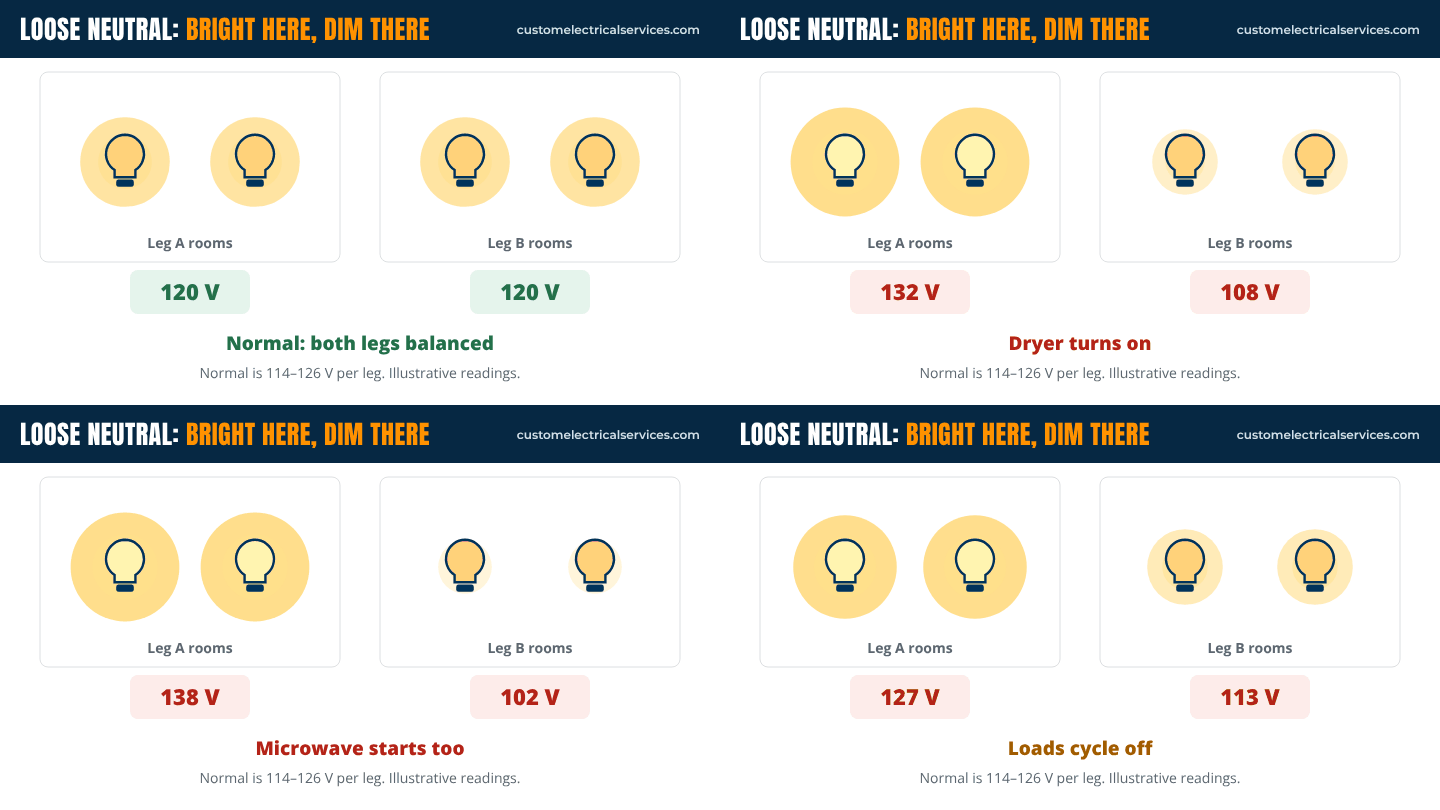
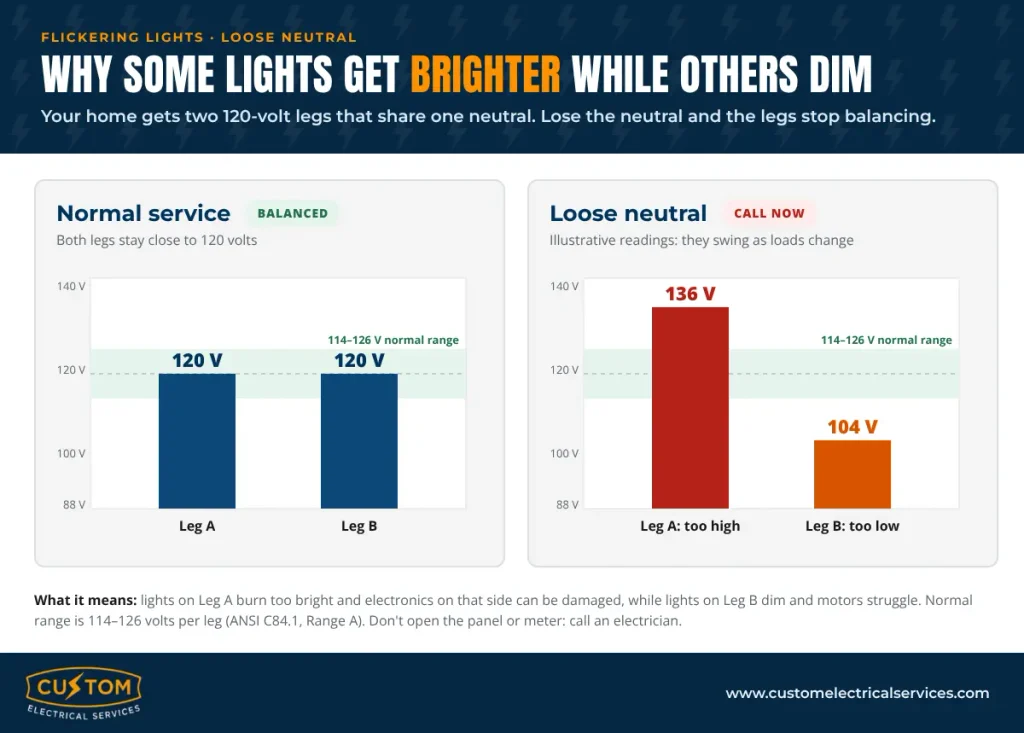
What’s happening: Your home gets two 120-volt “legs” from the utility plus a shared neutral wire that balances them. If that neutral is loose or corroded at the meter, the panel or the service line, the voltage on the two legs stops being even. One side of the house can jump well above 120 volts while the other sags below it, and the readings swing every time something turns on or off.
Signs:
- Flicker all over the house, not just one room
- Some lights unusually bright while others are dim, changing as appliances cycle
- Electronics, chargers or LED bulbs failing early
- Motors (fridge, furnace blower) humming or struggling
What to do: Treat this as urgent. Unplug sensitive electronics, don’t open the panel or meter, and call an electrician. If the problem is on the utility side, the electrician will tell you and you can call the utility.
Who fixes it: An electrician for the panel and meter box; the utility for the service line and meter.
7. A failing or overloaded panel
What’s happening: Breakers wear out, and the bus bars they clip onto can corrode or loosen. Some older panels, notably Federal Pacific Stab-Lok and Zinsco, have a known history of breaker problems. A 60- or 100-amp panel that was fine for the house in 1975 may be struggling with central air, an electric dryer and an EV charger today.
What to do: Have the panel inspected if it’s more than 25–30 years old, if you see rust, scorching or a buzz, or if it’s one of the brands above. See our guides to Federal Pacific panels and panel upgrades.
Who fixes it: An electrician.
8. Old or aluminum wiring
What’s happening: Many homes built in the mid-1960s to early 1970s have single-strand aluminum branch wiring. Aluminum expands and contracts more than copper, so its connections loosen and oxidize over time, which shows up as flicker, warm outlets and switches, and in the worst cases fires. Knob-and-tube wiring in pre-1940s homes has its own problems: brittle insulation, no ground and splices buried in walls and attics.
What to do: If your home was built in that era, or you see silver-colored wire at a switch or outlet, have it evaluated. Aluminum connections can often be repaired with approved connectors rather than a full rewire. See our knob-and-tube and rewiring pages.
Who fixes it: An electrician.
9. A problem at the service line, weatherhead or meter
What’s happening: The fault may be outside. Wind, ice and tree limbs strain the overhead service line, and the connections where it meets your weatherhead can loosen or corrode. Brief blinks during storms can also be the utility’s own protective equipment working: MidAmerican Energy says brief flicker is often its automatic protection limiting a surge, dip or outage on the grid.
What to do: If neighbors are flickering too, report it to your utility. For repeated flicker, MidAmerican asks customers to call 888-427-5632; it can install a recording voltmeter to monitor your power over time. Alliant Energy customers should contact Alliant’s customer service. If the problem is on your side of the meter, the utility will tell you to hire a licensed electrician.
Who fixes it: The utility for the line and meter; an electrician for the weatherhead, mast, meter box and panel.
Is it you or the utility?
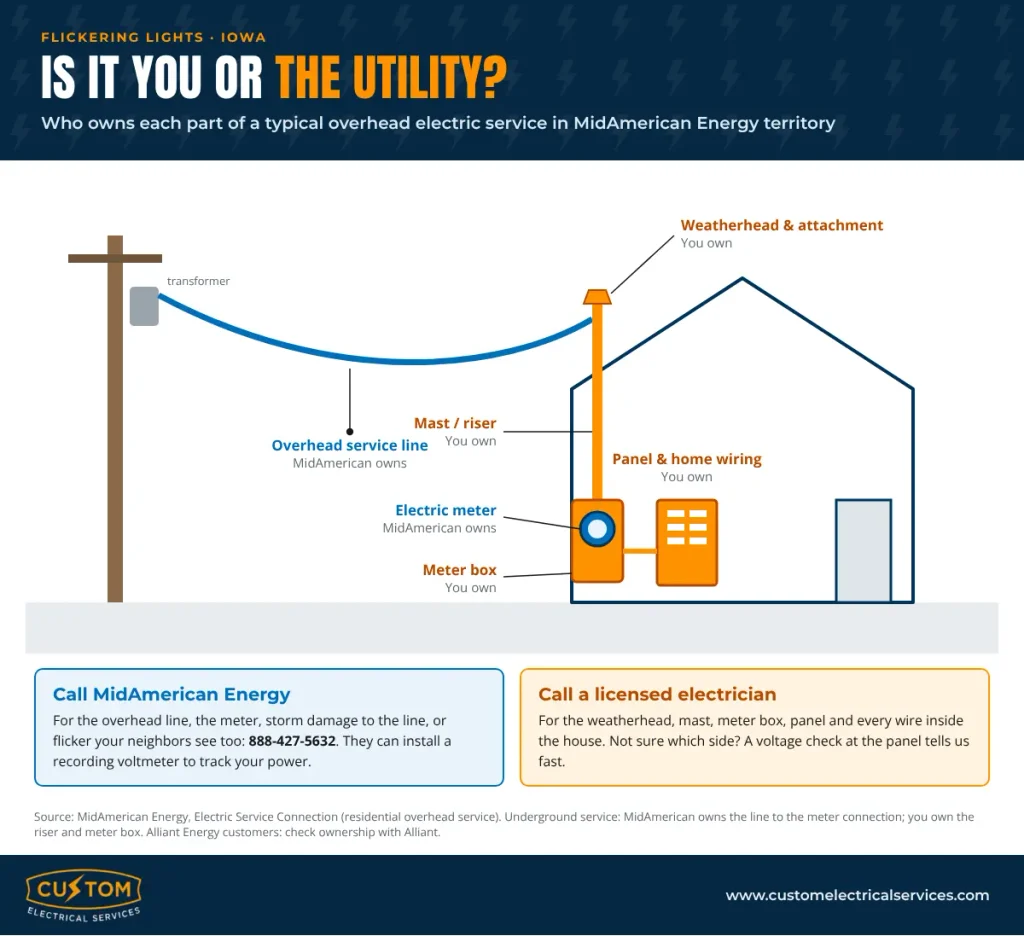
In MidAmerican Energy’s service area, the utility owns the overhead service line and the electric meter. The customer owns the weatherhead, the attachment hardware, the mast and the meter box. With an underground service, MidAmerican owns the line from the transformer to the meter connection, and the customer owns the riser and meter box. Alliant Energy’s arrangement is similar; check with Alliant for your address.
- Call the utility if neighbors are affected, if the flicker came with a storm or a downed limb, or if you can see damage to the line.
- Call an electrician for anything on the house: the weatherhead, mast, meter box, panel and all wiring inside.
- Not sure? Call an electrician. A voltage check at the panel shows quickly which side the problem is on.
Why Iowa homes flicker: what we see season by season
- Winter: Space heaters in basements and bedrooms, engine block heaters, and heat tape on garage circuits overload circuits that also feed lights. Cold also makes loose connections contract and lose contact.
- Summer: Central air starts dozens of times a day. In homes with 100-amp service or older panels, each start can dip the lights, and long heat waves expose weak connections.
- Storm season: Wind, ice, and derecho damage pull on overhead service lines and weatherheads. After the 2020 derecho, many Cedar Rapids-area homeowners needed an electrician to repair damaged service masts and meter boxes before the utility could reconnect them.
- Older neighborhoods: Older homes in Des Moines, Cedar Rapids, and Iowa City often have a mix of original and updated wiring and undersized panels. Mid-century homes may have aluminum branch wiring.
- Acreages and farms: Well pumps and outbuildings mean bigger voltage dips at start-up, and connections exposed to weather.
What an electrician checks on a flicker call
- Your description of the pattern: where, when and how often, using the table above.
- Voltage at the panel, on both legs, under load: normal residential service is about 114–126 volts per leg. Big differences between the legs point to a neutral problem.
- The service neutral and main connections: at the meter box, the main breaker and the panel’s neutral bar.
- Breakers and bus bars: for heat, corrosion, loose breakers or a problem panel brand. A thermal camera shows hot spots that eyes can’t.
- The affected circuit: switches, dimmers, outlets, fixtures and junction boxes, including backstabbed devices and aluminum connections.
- Coordination with the utility: if the readings point to the service line or meter, we tell you what to report so the utility can fix its side.
When to call an electrician right away
- Lights in different rooms brighten and dim at the same time
- A burning smell, scorch marks, or a switch or outlet that’s warm to the touch
- Buzzing or crackling from a switch, outlet, fixture or the panel
- Flicker together with breakers tripping
- Electronics or bulbs failing after the flicker started
- Flicker that started after storm damage to the line or mast
If you smell burning or see smoke, turn off the breaker for that area if you can do it safely, leave the house if needed, and call 911.
What it costs to fix flickering lights
| Repair | Typical cost |
|---|---|
| Replace a dimmer with an LED-rated model | $75–$200 |
| Tighten or repair a loose connection at a fixture, switch or outlet | $100–$250 |
| Diagnose and repair a panel problem | $200–$500+ |
| Replace a single breaker | $140–$260 |
| Full panel replacement | $1,500–$4,000+ |
Typical Iowa pricing. Utility-side repairs to the overhead line or meter are handled by the utility.
Frequently asked questions
Are flickering lights dangerous?
It depends on the cause. A loose bulb or a dimmer mismatch is harmless. Loose connections, a loose neutral, and failing breakers are fire and equipment hazards and need an electrician.
Why do my lights flicker when the AC turns on?
The compressor draws a surge of current when it starts, which briefly lowers the voltage for the rest of the house. A blink under a second is normal. Dimming that lasts several seconds, or flicker while the AC runs, points to an undersized service or a loose connection.
Why are some of my lights brighter and others dimmer?
That’s the classic sign of a loose or broken neutral at either the meter, the panel, or the service line. Treat it as urgent and call an electrician, because the high voltage on one side can damage electronics and appliances.
Why do my lights flicker only at night?
Evenings are when you and your neighbors run the most appliances, so voltage on your circuits and on the grid dips slightly. Persistent evening flicker is worth a voltage check, especially if it’s getting worse.
Why do my LED lights flicker?
Usually because they’re on a dimmer built for incandescent bulbs, on a smart switch without a neutral, or because the bulb has a low-quality driver. Use dimmable LEDs with an LED-rated dimmer.
My lights flicker in wind or storms. Is that normal?
Brief blinks can be the utility’s protective equipment working. Frequent flicker in wind can mean the service line or weatherhead connection is loose. Report it to MidAmerican (888-427-5632) or Alliant, and have an electrician check your weatherhead and meter box.
Can flickering lights damage my appliances?
Yes, especially with a loose neutral. Overvoltage shortens the life of electronics. A whole-home surge protector helps with spikes but won’t fix a loose neutral.
Can I fix flickering lights myself?
You can safely replace or tighten a bulb. Anything involving switches, outlets, fixtures, or the panel should be done by a licensed electrician. Iowa licenses electricians statewide, and panel work generally needs a permit and inspection.
Lights still flickering? We’ll find out why.
Custom Electrical Services has been tracking down flickering lights, loose connections and panel problems for Iowa homeowners since 2005, and now serves both sides of the Kansas City metro too. We answer the phone 24/7 and price the job before work starts.
Request a flickering lights repair