

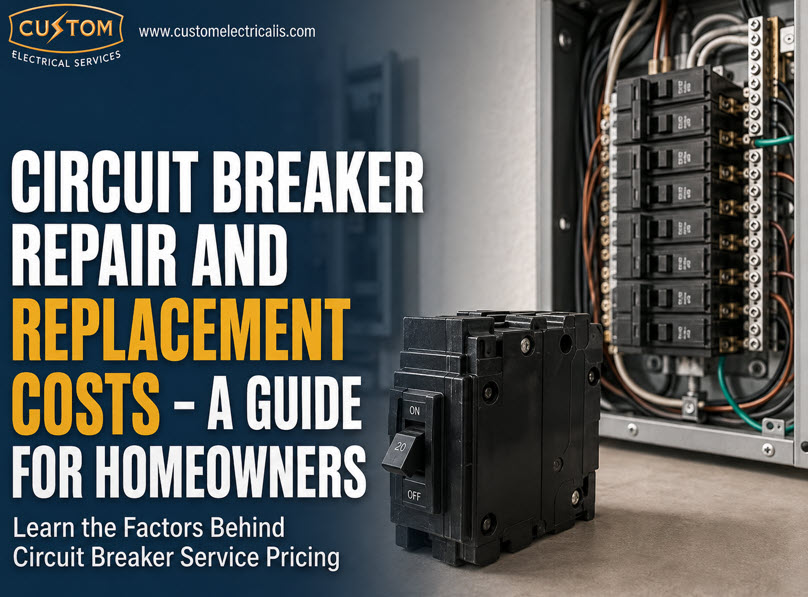
A breaker that trips once in a while is usually nothing to worry about. A breaker that trips every day, feels warm to the touch, or refuses to reset at all is a different story, and it’s the reason most Iowa homeowners start searching for a number: what is this circuit breaker service actually going to cost me?
The short answer is that most circuit breaker repairs in Iowa range between $140 and $650. The final price depends heavily on the breaker type, your panel’s condition, and whether the problem stops at the breaker or runs deeper into the wiring. At Custom Electrical, we’ve replaced breakers in farmhouses with panels older than the homeowners themselves and in new-builds where a single miswired connection tripped a brand-new AFCI breaker. The range is wide because every panel tells a different story.
This electrical panel pricing guide breaks down:
What Determines the Cost of a Circuit Breaker Repair?
Three things shape almost every invoice: what kind of breaker you need, what shape your panel is in, and how much digging it takes to find the actual fault. A simple swap on a modern panel is a quick, low-cost visit. A breaker failure caused by damaged wiring, corrosion, or an obsolete panel is a different job entirely, and pricing reflects that.
| Cost Driver | Why It Matters | Typical Price Impact |
|---|---|---|
| Breaker type (standard, GFCI, AFCI, dual-function) | Safety breakers cost more in parts and take longer to test | +$50 to +$200 |
| Panel age and brand | Obsolete or recalled panels (Zinsco, Federal Pacific) need extra care or full replacement | +$100 to +$1,500 |
| Root cause | If the breaker is a symptom of bad wiring, the wiring gets fixed too | +$150 to +$400 |
| Panel location | Cramped, finished, or hard-to-access panels add labor time | +$50 to $150 |
| Permits and inspection | Required in many Iowa municipalities for panel-level work | +$50 to $150 |
Circuit Breaker Repair and Replacement Costs in Iowa
Here’s what homeowners across Iowa typically pay, organized by the type of work involved.
| Circuit Breaker Service | Estimated Service Cost | Electrician’s Notes |
|---|---|---|
| Single standard breaker replacement | $140 to $260 | Most common repair; usually a same-visit fix |
| GFCI breaker replacement | $200 to $380 | Required in kitchens, bathrooms, and outdoor circuits |
| AFCI or dual-function breaker replacement | $230 to $450 | Increasingly required by code in bedrooms and living areas |
| Breaker plus wiring repair | $350 to $650 | When loose connections or damaged insulation are found |
| Obsolete panel component (Zinsco, Federal Pacific) | $500 to $1,800+ | Often requires full panel replacement rather than a single breaker swap |
| Emergency or after-hours service call | +$100 to $200 | Applies to burning smells, sparking, or total circuit loss |
These figures reflect general Iowa market pricing. A licensed electrician can only give you an exact number after seeing the panel in person, since a five-minute look often reveals whether you’re dealing with a simple swap or something bigger.
Does the Breaker Brand Affect the Circuit Breaker Service Price?
Yes, and it’s one of the more confusing parts of pricing for homeowners. Breakers aren’t universal. A Square D breaker won’t fit a Siemens panel, and an Eaton breaker won’t snap into a GE panel. That means the brand and age of your existing panel largely dictate which replacement parts your electrician can use, and how easy those parts are to source.
| Brand | Availability in Iowa | General Price Range (Standard Breaker) | Notes |
|---|---|---|---|
| Square D (QO and Homeline series) | Widely stocked | $25 to $60 per breaker (parts) | Common in newer Iowa construction; parts are easy to find |
| Eaton (BR and CH series) | Widely stocked | $25 to $65 per breaker (parts) | CH series is built to a tighter tolerance and costs slightly more |
| Siemens | Moderately available | $25 to $55 per breaker (parts) | Common in homes built or rewired in the last 20 years |
| GE (now ABB) | Increasingly harder to source | $30 to $75 per breaker (parts) | GE exited the breaker business; ABB-branded replacements can run higher |
| Cutler-Hammer (legacy Eaton) | Limited, often discontinued | $40 to $100+ per breaker (parts) | Common in homes from the 1970s and 80s; may require a full panel upgrade if stock runs out |
| Zinsco / Federal Pacific | Not manufactured | Panel replacement usually recommended | These panels have known safety issues; most electricians won’t install replacement breakers into them |
If your panel is a Zinsco or Federal Pacific Stab-Lok, you should know that both have well-documented histories of failing to trip during overloads. This defect is flagged by the U.S. Consumer Product Safety Commission in broader guidance on home electrical fire risks. In those cases, a full panel replacement is usually the safer and more cost-effective long-term move rather than sourcing increasingly rare parts for a single breaker.
Signs Your Circuit Breaker Needs Attention
A breaker’s job is to fail safely before your wiring fails dangerously, so any of these signs deserve an urgent electrical service call:
- Repeated tripping. If the same breaker trips more than once every week or two, something is overloading the circuit or the breaker itself is wearing out.
- Heat at the panel. A warm breaker or a panel cover that’s noticeably hot to the touch means power isn’t flowing the way it should. Turn off what you can and call an electrician the same day.
- Burning smell or discoloration. Scorch marks, melted plastic, or a burnt smell near the panel are urgent, not optional, signs.
- Buzzing or crackling sounds. Breakers should be silent. Noise usually means arcing inside the panel.
- Partial power loss. If one room or one set of outlets goes dark while everything else works fine, the breaker feeding that circuit has likely failed.
- A breaker that won’t reset. If flipping it back doesn’t restore power, or it trips again immediately, don’t keep trying. Repeated resets on a failing breaker can make the underlying problem worse.
Why Iowa Homes Have Their Own Set of Electrical Service Challenges
Iowa’s housing stock spans everything from century-old farmhouses to brand-new subdivisions, and that range shows up directly in panel condition.
Homes built before the 1980s often still carry original panels that were never designed for today’s electrical load. Modern conveniences such as central air, EV chargers, and a house full of devices didn’t exist when the panel was installed.
Newer Iowa homes are held to stricter code requirements around AFCI and GFCI protection, which means even a routine breaker swap may need to meet a higher standard than the original installation.
Many Iowa cities and counties also require permits and inspections for panel-level electrical work, which adds a step that homeowners in less-regulated areas might not expect. A permitted, inspected repair protects your home’s resale value and confirms the work meets current safety code, not just the code in place when your panel was first installed.
What Are the Signs You Need Circuit Breaker Replacement vs. Repair?
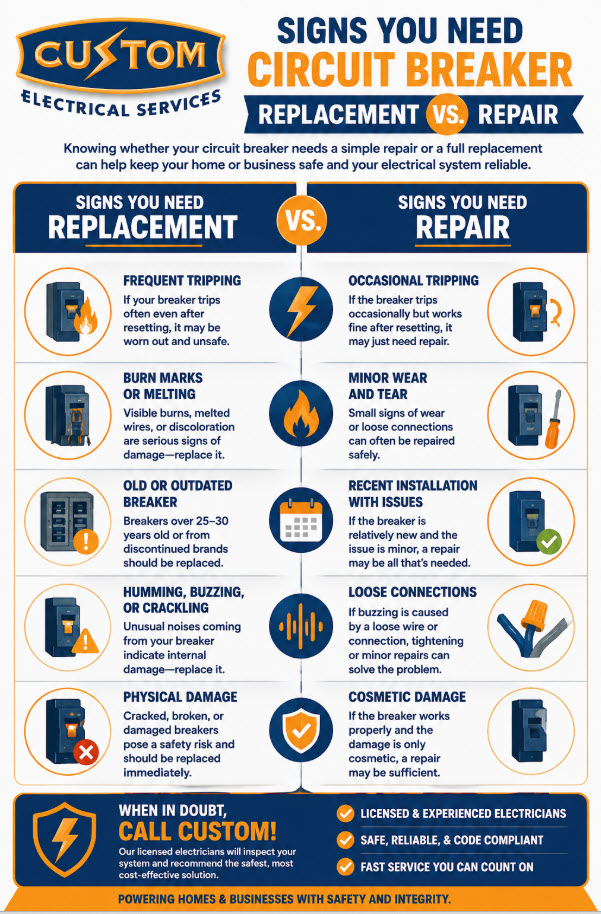
Not every breaker problem calls for a full panel replacement, but some do. As a general rule, a single failed breaker on an otherwise healthy, modern panel is a straightforward repair. A panel that’s outdated, undersized for your home’s current electrical demand, or built by a manufacturer with known safety recalls is a different conversation, one where a licensed electrician should walk you through the tradeoffs rather than swap parts and send an invoice.
At Custom Electrical, every service call starts with a full diagnostic of the panel, not just the breaker that’s acting up. That’s the only way to know whether you’re paying for the right fix the first time, instead of paying twice.
Book an Accurate Quote for Your Circuit Breaker Service
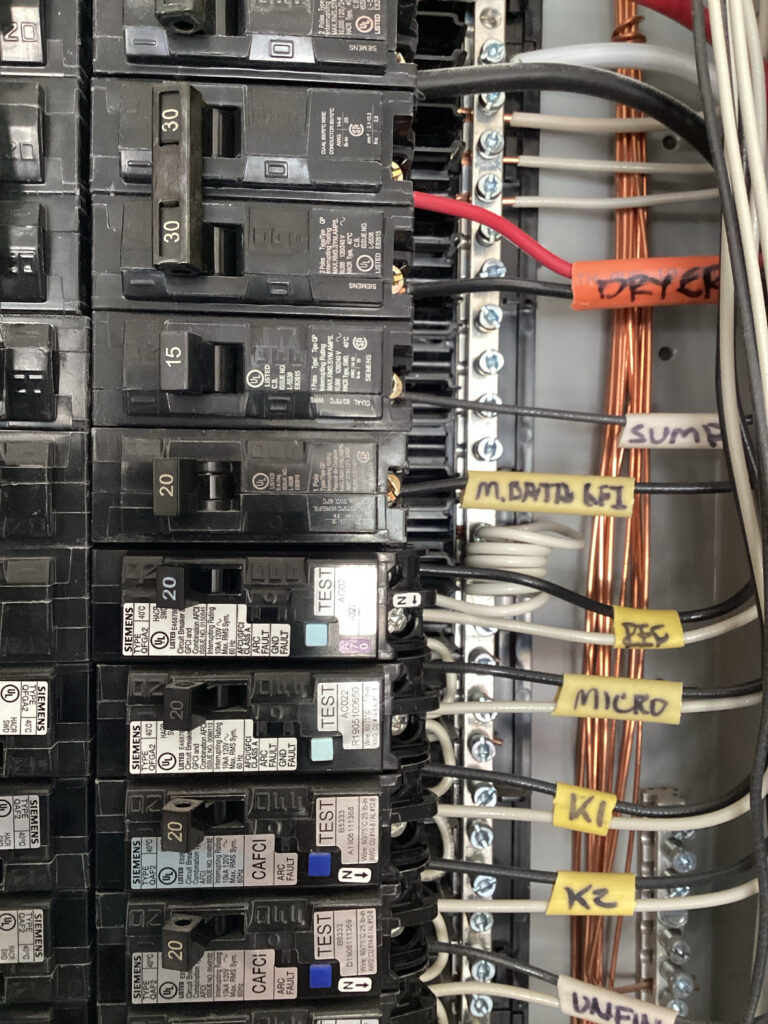
Every panel is different, and the only way to know your real number is to have a licensed electrician take a look. Custom Electrical Services offers upfront, itemized pricing before any work begins, so you know exactly what you’re paying for and why. If your breaker is tripping, humming, or not performing to your requirements, schedule a home visit with our team.
Answers to Your Frequently Asked Circuit Breaker Cost Questions
How much does it cost to replace a circuit breaker in Iowa?
Most single breaker replacements in Iowa cost between $140 and $260, including labor and parts. GFCI and AFCI breakers run higher, typically $200 to $450, because they cost more to source and take longer to test properly.
Can I replace a circuit breaker myself?
Most homeowners shouldn’t. A panel carries enough current to cause serious injury, and an improperly seated breaker can create a fire risk that’s invisible until it’s too late. It’s one of the few electrical jobs worth leaving to a licensed professional every time.
Why does my breaker keep tripping even after I reset it?
A breaker that trips repeatedly is doing its job: protecting the circuit from an overload, a short, or a ground fault. Continuing to reset it without diagnosing the cause delays the real fix and can allow damage to build behind the scenes.
Is a hot circuit breaker dangerous?
Yes. A breaker that feels warm or hot to the touch is a sign of a loose connection, an overloaded circuit, or a failing internal component. Turn off what you can safely access and call an electrician the same day rather than waiting.
How do I know if my whole panel needs to be replaced instead of just a breaker?
If your panel is a known problem brand (Zinsco or Federal Pacific), if it’s undersized for your home’s current electrical load, or if multiple breakers are failing around the same time, a full panel replacement is usually more cost-effective than repeatedly patching individual breakers.
Do circuit breaker repairs require a permit in Iowa?
Many Iowa municipalities require a permit and inspection for panel-level electrical work, including breaker replacement in some cases. A licensed electrician will know your local requirements and can pull the permit as part of the job.
What’s the difference between a GFCI and an AFCI breaker?
A GFCI (ground-fault circuit interrupter) breaker protects against electrical shock by detecting current leaking to ground, commonly required in kitchens, bathrooms, and outdoor circuits. An AFCI (arc-fault circuit interrupter) breaker detects dangerous arcing in the wiring itself and is increasingly required in bedrooms and living spaces. Dual-function breakers combine both protections.
Can a bad breaker damage my appliances?
Yes. A failing breaker may not trip when it should, allowing an overload or surge to reach connected appliances and electronics. This is why a breaker that isn’t tripping properly is often more concerning than one that trips too often.
How long does a circuit breaker repair take?
A standard single breaker swap usually takes 30 to 90 minutes. Jobs involving wiring repairs, obsolete parts, or a full panel evaluation can take several hours or a separate, longer visit.
Are Square D, Eaton, and Siemens breakers interchangeable?
You cannot mix breaker brands because each panel features a proprietary busbar design with unique dimensions and clip configurations. Forcing a mismatched breaker creates a fire hazard and violates electrical codes. Square D offers the premium QO series with a three-quarter-inch width and the standard one-inch Homeline series, which are not even interchangeable. Eaton similarly produces the premium three-quarter-inch CH series and the standard one-inch BR series. Siemens utilizes a standard one-inch design. Even among one-inch breakers, the seating depths and terminal geometries remain strictly unique to each manufacturer.