

If a full charge on your standard 120-volt outlet takes longer than your car sits in the driveway, you’ve already outgrown Level 1 charging. This guide breaks down the technical thresholds that signal it’s time to upgrade to a Level 2 EV charger, plus the real-world numbers behind the switch.
Level 1 vs. Level 2 EV Chargers
Level 1 charging uses a standard 120-volt household outlet and typically delivers 3 to 5 miles of range per hour. Level 2 charging runs on a 240-volt circuit — the same voltage class as an electric dryer — and delivers 20 to 40 miles of range per hour, roughly a 6-8x speed increase.
| Factor | Level 1 (120V) | Level 2 (240V) |
| Voltage | 120V | 208-240V |
| Amperage | 12-16A | 16-80A (commonly 32-48A) |
| Charging speed | 3-5 mi/hour | 20-40 mi/hour |
| Full charge time (60 kWh battery) | 20-40+ hours | 4-10 hours |
| Circuit required | Standard outlet | Dedicated 40-60A circuit |
| Typical install cost | $0 (existing outlet) | $800-$2,500 |
Five Signs You Need to Upgrade
1. Your daily commute exceeds 40 miles
At Level 1 speeds, an 8-hour overnight charge only recovers 24-40 miles — not enough to cover a moderate commute plus errands.
2. You’re driving a plug-in hybrid or EV with a battery over 60 kWh
Larger battery packs require proportionally longer Level 1 charge windows, often exceeding 40 hours for a full charge from empty.
3. Your household is adding a second EV
Two vehicles sharing one Level 1 outlet creates a charging bottleneck that a dedicated 240V circuit resolves.
4. You need charge flexibility for late arrivals or early departures
Level 2’s 4-10 hour full-charge window fits a normal overnight sleep cycle; Level 1 often doesn’t.
5. Your utility offers time-of-use (TOU) discounted overnight rates
Level 2’s faster charge rate lets you complete a full charge entirely within cheaper off-peak windows, maximizing savings.
Amperage and EV Charger Selection
Level 2 chargers are sold at different amperage ratings, and the right one depends on your vehicle’s onboard charger capacity and your electrical panel’s available capacity. Installing above your vehicle’s maximum onboard charge rate provides no additional speed — matching the charger to the vehicle (not just the panel) avoids overspending.
| Charger Amperage | Circuit Breaker Size | Approx. Range Added/Hour | Best For |
| 16A | 20A | 10-12 mi | Small EVs, limited panel capacity |
| 32A | 40A | 20-25 mi | Most sedans and compact SUVs |
| 40A | 50A | 25-30 mi | Larger EVs, faster overnight recovery |
| 48A | 60A | 30-37 mi | High-capacity onboard chargers |
For most daily drivers, a Level 2 charger pays for itself with speed of charging convenience within the first month, independent of any fuel-cost savings versus gasoline.
| Scenario | Level 1 Weekly Charge Time | Level 2 Weekly Charge Time | Time Saved |
| 200 mi/week driver | ~50 hours | ~7 hours | 43 hours |
| 350 mi/week driver | ~90+ hours | ~12 hours | 78+ hours |
Panel Capacity: The Often-Overlooked Factor When Planning EV Charger Upgrades
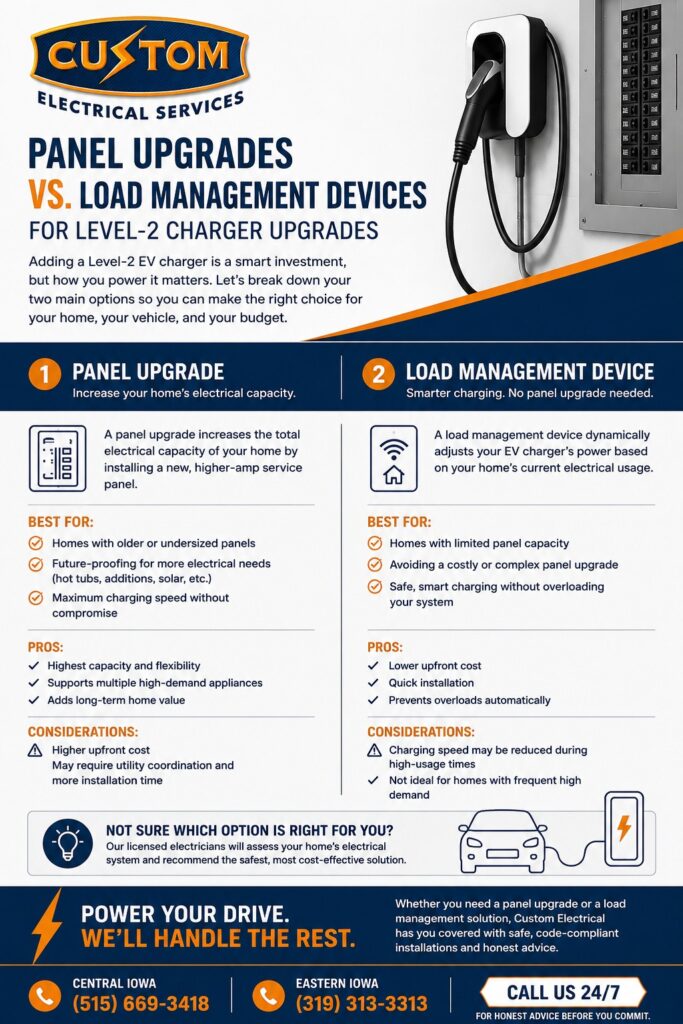
Before upgrading, a licensed EV charger installer should confirm your home’s electrical panel has sufficient spare capacity (typically 40-60 amps) for a dedicated EV circuit.
Homes with older 100-amp panels frequently need a panel upgrade or load management device alongside the charger install, which is a step DIY installers often miss, leading to code violations or breaker trips.
Ready to Upgrade? Schedule Your Level-2 Charger Installation Quote!
Choosing the right amperage, circuit, and charger location takes more than a trip to the hardware store. You need a licensed electrician who understands your panel’s capacity and your vehicle’s charging profile.
Custom Electrical installs code-compliant Level 2 EV chargers tailored to your home and driving habits, from panel assessment through final inspection. Contact Custom Electrical today for a free consultation and get your home ready for faster, safer overnight charging.
Answers to Level-2 Charger Frequently Asked Questions
How does a Level 2 EV charger actually work?
A Level 2 charger draws 240V AC power through a dedicated circuit and delivers it to your vehicle’s onboard charger, which converts it to DC to store in the battery — at roughly 6-8x the speed of a standard outlet.
Do I need an electrician to install a Level 2 charger?
Yes. Level 2 installs require a dedicated 240V circuit, proper breaker sizing, and code-compliant wiring — work that should be done by a licensed electrician.
What’s the difference between hardwired and plug-in Level 2 chargers?
Hardwired units connect directly to the circuit for slightly higher amperage support; plug-in units use a NEMA outlet, offering portability and easier future upgrades.
Can a Level 2 charger damage my EV battery over time?
No. Level 2 charging is within manufacturer-recommended limits and is generally gentler on battery health than DC fast charging.
How much does a Level 2 charger add to my electric bill?
Cost depends on local electricity rates and miles driven, but most owners see $30-$60/month in added charging costs, often offset by TOU discounts.
Can I use a Level 2 charger outdoors?
Yes, provided the unit is rated NEMA 3R or higher for outdoor/weather exposure and is properly grounded per code.
Will upgrading to Level 2 increase my home’s resale value? A professionally installed Level 2 charger is increasingly viewed as a value-add feature, particularly in markets with high EV adoption.