

Quick answer
Most breakers won’t reset because they were never pushed all the way to OFF first. A tripped breaker rests in the middle, and it has to be forced fully off until it clicks before it will latch back on. If it still won’t stay on, the cause is usually an overload (too much running on the circuit), a short circuit or ground fault (damaged wiring or a faulty appliance), or a worn-out breaker.
- Unplug or switch off everything on the circuit, push the handle firmly to OFF, then back to ON. Try once.
- If it trips instantly, there’s an active fault. Don’t keep resetting it.
- If it holds for a few minutes and then trips, the circuit is overloaded. Use the load check below.
- A hot, buzzing or burning-smelling breaker or panel means stop and call an electrician now.
How to reset a breaker correctly
Breakers use a trip-free latch. When they trip, the handle drops to a middle position and the internal latch lets go. Pushing straight from the middle to ON does nothing, because the latch hasn’t been re-set. You have to push past OFF first.
What happens inside a breaker when it trips
A standard household breaker has two separate ways to trip. Knowing which one fired tells you a lot about the problem.
Thermal trip (overloads). The current heats a strip made of two bonded metals that expand at different rates. A modest overload bends it slowly, so the breaker trips after seconds or minutes. Because the strip has to cool before it can latch again, a breaker that tripped from overload may refuse to reset for a minute or two.
Magnetic trip (short circuits and ground faults). A dead short sends current to many times the breaker’s rating. That surge turns the coil into a magnet strong enough to yank the trip bar almost instantly. A breaker that snaps off the moment you push it on is almost always tripping magnetically, which means the fault is still there.
Troubleshooter: what does the breaker do when you push it ON?
How the breaker behaves narrows the cause down faster than anything else. Pick the closest match.
It wasn’t pushed fully to OFF, or the latch is worn
- Most likely
- The internal latch hasn’t been re-set. A tripped breaker has to travel all the way past OFF and click before it will hold ON.
- Do this
- Push the handle firmly to OFF until it clicks, wait a minute, then push to ON. If it still won’t latch with nothing connected, the breaker’s mechanism has likely failed and needs replacing.
The 9 most common reasons a breaker won’t reset
The bars show how serious each cause usually is.
It wasn’t pushed fully to OFF
SeverityThis is the most common reason by far, and there’s nothing wrong with the circuit. The handle looks like it moved, but the latch never re-set.
The breaker is still hot from an overload
SeverityAfter a thermal trip, the bimetal strip stays bent until it cools. Until then, the breaker either won’t latch or trips again within seconds.
The circuit is overloaded
SeverityToo much is running on one circuit. Space heaters, hair dryers, microwaves, window AC units and toasters each draw 10 to 15 amps on their own. Two of them on a 15-amp bedroom or bathroom circuit is enough to trip it. Repeated overloads also wear the breaker and heat the wiring.
A faulty appliance or cord
SeverityA damaged cord, a failing motor or water inside an appliance can short or leak current to ground the moment it’s powered. The circuit wiring is fine; the device isn’t.
A short circuit in the wiring
SeveritySomewhere a hot wire is touching a neutral, often at a loose outlet or switch, a nail or screw through a cable, a crushed wire behind a box, or insulation chewed by rodents. The magnetic trip fires instantly, every time.
A ground fault
SeverityCurrent is escaping to ground through a metal box, a damp outlet, or a person. Outdoor outlets, garages, basements, sump pumps and anything near water are the usual suspects, especially after heavy rain or a thaw.
An AFCI or GFCI breaker detecting a wiring problem
SeveritySafety breakers watch for things a standard breaker can’t see: tiny arcs (AFCI) or a few thousandths of an amp leaking to ground (GFCI). In older homes they often trip because of how the circuit was wired, not because anything is plugged in. More on this below.
The breaker itself has failed
SeverityBreakers are mechanical. After decades or after many trips, springs weaken, latches wear and contacts pit. A failed breaker may not latch at all, or may trip well below its rating.
A problem in the panel
SeverityA loose or burnt connection where the breaker clips onto the bus, water in the panel, or a panel with a known history of breaker problems. Federal Pacific Stab-Lok and Zinsco panels, common in homes built from the 1950s through the 1980s, are the two names electricians watch for.
Load check: is the circuit overloaded?
Tick what was running on the circuit when it tripped. The bar compares the total with the breaker’s rating and with 80% of it, the limit for loads that run for three hours or more, such as a space heater.
Wattages are typical figures for illustration; check the label on your own appliances. Motors and compressors also draw a brief surge when they start.
AFCI and GFCI breakers follow different rules
If the stuck breaker has a TEST button, a curly white wire to the neutral bar or a “plug-on neutral” clip, it’s a safety breaker. The National Electrical Code now calls for AFCI protection on most living-area circuits and GFCI protection in kitchens, bathrooms, garages, basements, laundry areas and outdoors, so most newer homes and remodels have plenty of them.
| Type | What it detects | Common reasons it won’t reset |
|---|---|---|
| AFCI arc-fault | Small, irregular arcs from damaged cords, loose connections or nicked wires | Loose backstab connection at an outlet; a wire nicked by a picture nail; a neutral shared with another circuit; some motors, treadmills and older vacuums |
| GFCI ground-fault | About 5 milliamps leaking to ground (a person or water) | Moisture in an outdoor or basement outlet; a neutral touching ground in a box; a sump pump, freezer or heat-pump unit with leakage |
| Dual function | Both of the above | Any of the above. Many models show a trip-cause indicator; check the breaker’s label for what its lights mean. |
Older homes often have two circuits sharing one neutral wire (a “multi-wire branch circuit”), or a neutral that touches ground somewhere. A standard breaker never noticed. A safety breaker sees the imbalance and trips the instant it’s switched on. The fix is in the wiring, not the breaker, and an electrician can find it with a circuit trace.
When it’s the main breaker that won’t reset
First check whether the power is actually off at the street: look at your neighbors’ lights and your utility’s outage map. In Kansas City that’s Evergy; in central Iowa it’s usually MidAmerican Energy, and in Cedar Rapids, Iowa City and much of eastern Iowa, Alliant Energy. If the street has power, a main breaker that trips or won’t reset points to a serious overload across the whole service, a fault in the panel, or a problem at the meter or service entrance.
If half the house is out and the other half works, one of the two incoming 120-volt legs may have failed, which is often a utility or service-connection problem. Call the utility first if the lights in the working half look dim or unusually bright, then an electrician. See a real main-breaker replacement in Johnston, Iowa.
Featured repair: a charred 100-amp main breaker in Johnston, Iowa
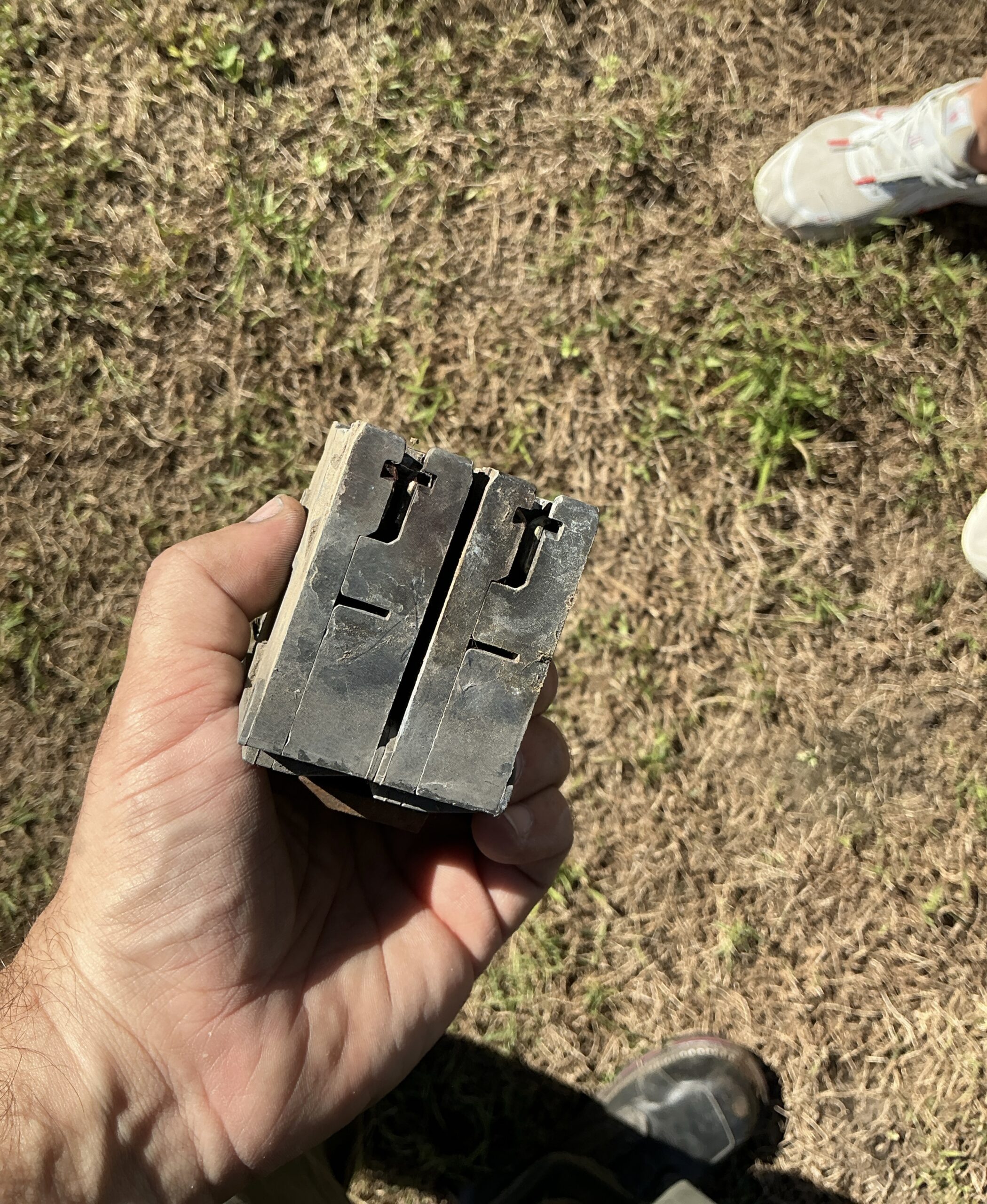
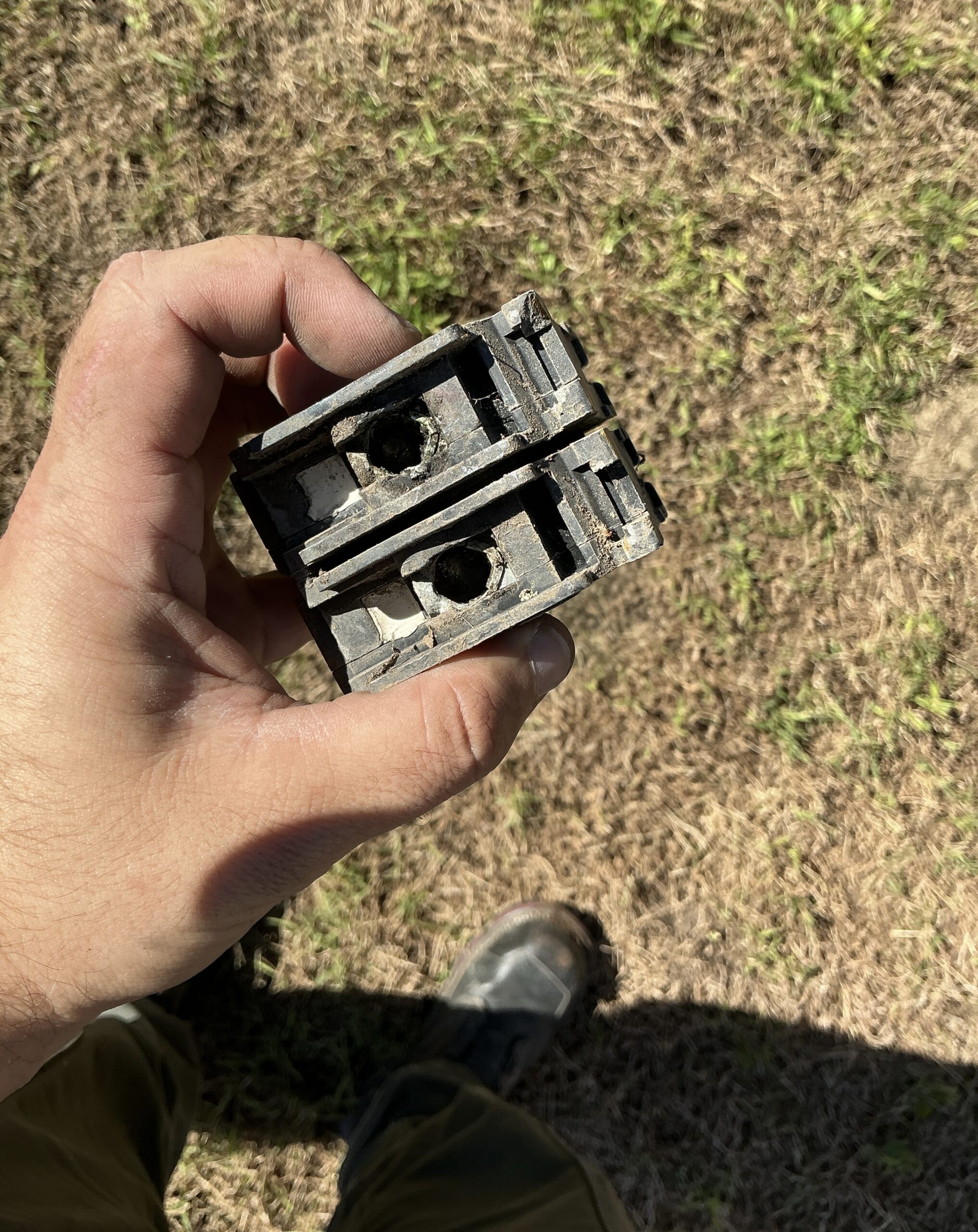
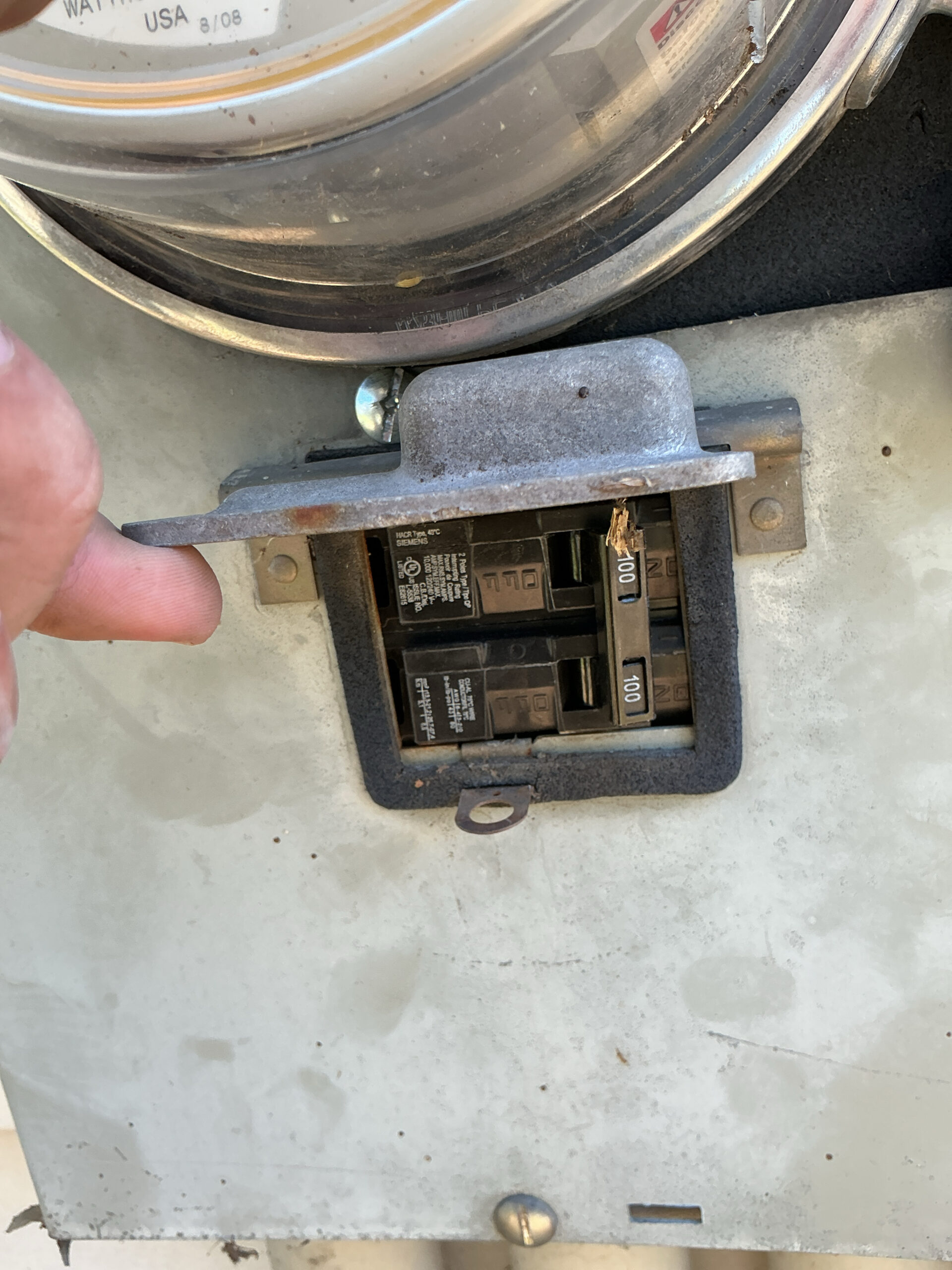
Sometimes the breaker won’t do its job because the breaker itself has burned. This Johnston home had its main breaker outside, in the same metal enclosure as the electric meter (a “meter-main” combination, sometimes called a meter stack). That breaker had failed, and no amount of resetting would have fixed it.
- Date
- October 6, 2026
- Location
- Johnston, Iowa
- Electrician
- Danny Gabel, Custom Electrical Services
- Equipment
- 100-amp, 2-pole main breaker in the meter enclosure
- Utility
- MidAmerican Energy
- Result
- 240 volts confirmed at the new breaker
- If your main breaker is outside at the meter and won’t reset, or the house (or half of it) has no power while the neighbors do, the breaker or its connections may be damaged.
- Warning signs at the meter enclosure: scorch marks, melted plastic or a burning smell. Lights dimming or flickering across the whole house can come first.
- Don’t open the enclosure or cut the utility’s seal. The wires feeding the main breaker are live and can’t be shut off from your side.
- Call a licensed electrician. We coordinate the disconnect with your utility (MidAmerican, Alliant or Evergy), replace the breaker and verify the voltage before we leave.
What not to do
When to call an electrician
- It trips the instant you reset it, even with everything unplugged
- You smell burning plastic, or see scorch marks on an outlet, switch or the panel
- The breaker or panel cover is hot, buzzing or crackling
- Water has reached the panel or the outlets on that circuit
- The main breaker won’t reset and the utility has power to the street
- Your panel is a Federal Pacific Stab-Lok or Zinsco

Schedule a visit soon (not an emergency) if the same breaker trips every week, an AFCI or GFCI breaker trips with nothing plugged in, or you keep running into the limit of a circuit. Those are signs the circuit or panel needs to change, not that you need to reset more carefully.
When you call, a live person answers 24/7. Tell us what the breaker is doing (won’t latch, trips instantly, or trips after a few minutes) and we’ll send an electrician with the right breaker for your panel on the truck.
What it costs to fix a breaker that won’t reset
| Repair | Typical cost | Notes |
|---|---|---|
| Single standard breaker replacement | $140–$260 | The most common repair; usually fixed the same visit |
| GFCI breaker replacement | $200–$380 | Kitchens, bathrooms, garages and outdoor circuits |
| AFCI or dual-function breaker replacement | $230–$450 | Bedrooms and living areas |
| Breaker plus wiring repair | $350–$650 | When loose connections or damaged insulation are found |
| Obsolete panel (Zinsco, Federal Pacific) | $500–$1,800+ | Often means replacing the panel rather than one breaker |
| Emergency or after-hours visit | +$100–$200 | Burning smells, sparking or total circuit loss |
From our Iowa circuit breaker repair cost guide. Kansas City pricing is quoted per job; ask for an upfront price before work starts.
What we see in Kansas City homes
- Older homes with modern breakers. In pre-war neighborhoods on the Missouri side (Brookside, Waldo, Hyde Park, the Northeast) and in older parts of Kansas City, Kansas, safety breakers added during a remodel often trip as soon as they’re switched on. The usual cause is a shared neutral or a neutral touching ground somewhere in decades-old wiring, which a standard breaker never detected.
- Mid-century suburbs, mid-century panels. Many homes in Johnson County suburbs such as Prairie Village, Mission, Overland Park and Merriam were built in the 1950s through the 1970s, the era when Federal Pacific and Zinsco panels were installed. When a breaker in one of those panels won’t reset, we check the panel before replacing the breaker.
- Summer heat and storm season. Long stretches of central air plus window units push older circuits to their limit in July and August. Spring thunderstorms bring surges and wet outdoor outlets, the classic recipe for a GFCI breaker that won’t hold.
- Licensing varies across the state line. Kansas doesn’t license electricians statewide; Johnson County, Kansas City, Kansas, and Kansas City, Missouri each set their own licensing and permit rules. Breaker and panel work should be done by an electrician licensed for your city.
Serving Kansas City, MO, Kansas City, KS, Overland Park, Olathe, Lenexa, Shawnee, Leawood, Independence and Lee’s Summit. Kansas City electricians
Our experience in Iowa homes
- Winter is overload season. Space heaters in basements and bedrooms, engine block heaters and heat tape on garage circuits are the loads behind most of the “trips after ten minutes” calls we get between December and February. The fix is usually a dedicated circuit, not a bigger breaker.
- Basements, sump pumps and spring thaws. Basement and garage circuits often feed sump pumps and chest freezers, which commonly sit on GFCI protection. A wet spring or a failing pump motor can leave a GFCI breaker refusing to reset, so check the sump as soon as power is back.
- Farmhouses and century homes. We’ve replaced breakers in farmhouse panels older than the homeowners. Rural service upgrades, outbuilding feeds and decades of add-on circuits mean an old panel often needs more than a breaker swap.
- Main breakers at the meter. Many Iowa homes have the main breaker outdoors in the meter enclosure, where heat, moisture and loose connections take a toll. On October 6, 2026, Danny Gabel replaced a charred 100-amp main breaker at a home in Johnston after MidAmerican pulled the meter. See the photos.
- Storm and flood damage. After the 2008 floods and the 2020 derecho in Cedar Rapids, many panels and breakers were exposed to water. Breakers that have been submerged should be replaced, not dried out and reset.
- Licensed statewide. Iowa licenses electricians through the Iowa Electrical Examining Board, and panel work generally needs a permit and inspection from the state or your city.
Serving Des Moines, West Des Moines, Ankeny, Urbandale, Ames, Cedar Rapids, Iowa City and Coralville. Residential electrical services
Frequently asked questions
Why won’t my breaker reset even with nothing plugged in?
If it won’t latch at all, it was probably not pushed fully to OFF, or its mechanism has failed. If it latches but snaps off instantly, there’s a short circuit or ground fault in the wiring itself, at an outlet, switch, fixture or cable. Leave it off and call an electrician.
How long should I wait before resetting a tripped breaker?
One to two minutes is usually enough. Overload trips heat a bimetal strip inside the breaker, and it has to cool before the breaker will latch again.
How many times can I try to reset a breaker?
Once after removing the load, and once more after waiting. If it trips immediately both times, stop. Repeatedly closing a breaker into a short circuit stresses the breaker and the wiring.
Why does my breaker click but not stay on?
The click means the latch has re-set. If it then trips as soon as you push it ON, the breaker is responding to a fault on the circuit (or it has worn out and trips below its rating).
Can a circuit breaker go bad?
Yes. Springs, latches and contacts wear with age and with every trip. A breaker that won’t latch with no load, feels loose, or runs warm should be replaced.
Can I put in a bigger breaker so it stops tripping?
No. The breaker size is matched to the wire. A 15 A circuit normally uses 14-gauge wire and a 20 A circuit 12-gauge. A larger breaker lets the wire overheat before anything trips.
Why does my new AFCI or GFCI breaker trip immediately?
Usually because of how the circuit is wired: a neutral shared with another circuit, or a neutral touching ground in a box. Standard breakers ignore these conditions; safety breakers don’t.
Is a breaker that won’t reset an emergency?
It is if there’s heat, a burning smell, buzzing, scorch marks or water. Otherwise it’s urgent but not an emergency: leave the breaker off and book an electrician.
What’s the difference between a tripped breaker and a blown fuse?
Both stop current when there’s too much. A fuse melts and must be replaced; a breaker trips and can be reset. If your home still has a fuse box, that’s often a sign the electrical system is due for an upgrade.
Breaker still won’t reset? We’ll find out why.
Family owned since 2005, serving central and eastern Iowa and both sides of the Kansas City metro. We answer the phone 24/7 and price the job before work starts.
Fill out our short form and tell us what the breaker is doing. We’ll call you back to schedule.
Or call your nearest office
Related guides
This guide is general information. Electrical work can be dangerous; if you’re unsure, leave the breaker off and call a licensed electrician.