



The wiring behind your walls might be knob-and-tube strung through ceramic insulators, cloth-wrapped cable with no ground wire, aluminum circuits from the late 1960s, or modern grounded copper. In Kansas City, many homes have more than one type. The bungalows and Tudors of Brookside, Waldo, and Hyde Park, the mid-century ranches of the Northland and Raytown, and the newer builds in Lee’s Summit and Olathe were each wired to the standards of their day. Those standards didn’t account for EV chargers, home offices, or space heaters running through a January cold snap.
Knowing what’s behind your walls helps you spot problems early, budget for upgrades, and avoid surprises when you buy, sell, or renovate.
Kansas City Wiring Types, Decade by Decade
A home’s age is the best first clue. Renovations over the decades often leave a mix of wiring types in the same house, so use this table as a starting point rather than a diagnosis.
| Era Your Home Was Built | Common Wiring Style | Potential Electrical Issues |
|---|---|---|
| Before the 1940s | Knob-and-tube | Has no ground wire, and its insulation can become brittle with age. It was never designed to be buried in modern insulation. |
| 1940s–1960s | Cloth-sheathed cable, often two-prong | Usually ungrounded. The sheathing can crack and crumble, especially near light fixtures and in hot attics. |
| Mid-1960s–early 1970s | Aluminum branch circuits in some homes | Connections can loosen and overheat if devices aren’t rated for aluminum. |
| 1970s–today | Copper cable with a ground wire | Generally sound, but older panels and missing modern protection are common in homes from the 1970s through the 1990s. |
Older Wiring and Panels Common in Kansas City Homes
Kansas City’s older neighborhoods feature homes updated piece by piece over the decades. A 1920s house in Hyde Park might have a newer kitchen circuit, original knob-and-tube in the upstairs bedrooms, and a panel added in the 1970s.
These are the older systems electricians run into most often across the metro.
Knob-and-Tube Wiring
You’ll spot it in attics and unfinished basements, as single wires strung through ceramic tubes and wrapped around ceramic knobs. Much of what remains in Kansas City homes has been partly disconnected or spliced into newer wiring, making it hard to know what’s still live. Our guide to replacing knob-and-tube wiring covers how to identify it and what replacement involves.
Cloth-Sheathed and Ungrounded Cable
Common in homes built from the 1940s into the 1960s, this cable has a woven fabric jacket and usually just two conductors with no ground. The jacket and the insulation underneath tend to break down where heat collects, such as inside ceiling light boxes.
Aluminum Branch Wiring
Some homes built during the mid-1960s and early 1970s used aluminum wire for outlet and lighting circuits. The wire itself isn’t the main concern. The trouble is at connections, where aluminum expands, contracts, then oxidizes differently than copper. Remediating the connections or replacing the circuits removes the risk.
Outdated Panels: Zinsco, Federal Pacific, and Fuse Boxes
The panel matters as much as the wiring. Some older panel brands have a reputation for breakers that may not trip when they should, which defeats the purpose of having a breaker at all.
| Panel Type | How to Spot It | Why Electricians Recommend Replacing It |
|---|---|---|
| Zinsco (also sold as Sylvania-Zinsco) | Breakers in pastel colors such as blue, green, and red, with “Zinsco” or “Sylvania” on the panel label | Breakers can fuse to the bus bar and fail to trip, and bus bars are prone to overheating |
| Federal Pacific Electric (FPE) Stab-Lok | “Federal Pacific” or “Stab-Lok” on the label, with red-tipped breakers | Breakers have a long-documented history of failing to trip under overload |
| Fuse box | Screw-in round fuses instead of breakers | Often limited capacity, and oversized fuses can be installed in place of the correct ones |
| 60-amp service | A 60-amp main breaker or main fuse | Too little capacity for central air, modern kitchens, or an EV charger |
Both brands share the same core problem: breakers that may not trip, so they can’t stop an overloaded or shorted circuit from overheating
In Zinsco panels, breakers can fuse to an aluminum bus bar that loosens and overheats over time, which is why many electricians recommend replacing Zinsco breakers and panels rather than repairing them.
Federal Pacific Stab-Lok breakers have a long record of failing to trip under overload, and a loose fit can cause arcing at the bus bar. That’s why replacing an FPE panel is usually the safer choice. In either type of panel, don’t keep resetting a breaker that trips repeatedly. Have the panel evaluated instead.
Why Older Wiring Struggles in Today’s Homes
Older wiring isn’t automatically dangerous, but it was built for a lighter load. A 1925 home was wired for a few lights and a radio. Today the same circuits may power a microwave, a window AC unit through a humid Kansas City summer, and a laptop charger in every room.
That extra demand shows up as tripping breakers, warm outlets, and lights that flicker when appliances kick on. Two-prong outlets without a ground also leave electronics with less protection, and they’re one reason some insurers ask questions about older systems before writing a policy.
![Kansas City home wiring warning signs sorted by urgency, from burning smells to two-prong outlets]](https://customelectricalservices.com/wp-content/uploads/ce-kc-wiring-warning-signs-1024x862.webp)
Modern Electrical Safety Systems Every Kansas City Home Should Consider
You don’t always need a full rewire to make a home safer. Several upgrades add protection to the wiring you already have:
| Upgrade | The Benefits | Applications in the Modern Kansas City Home |
|---|---|---|
| GFCI protection | Cuts power in a fraction of a second when current leaks to ground, helping prevent shocks | Kitchens, bathrooms, laundry areas, garages, basements, and outdoors |
| AFCI breakers | Detect dangerous arcing in damaged or loose wiring before it can start a fire | Bedrooms and living areas, and especially valuable in older homes |
| Tamper-resistant outlets | Built-in shutters block objects from being pushed into the slots | Any home with young children or grandchildren visiting |
| Whole-home surge protection | Limits voltage spikes before they reach your appliances and electronics | Homes with smart appliances, HVAC controls, or home offices |
| Panel upgrade | Adds capacity and space for new circuits, and replaces outdated equipment | Homes adding an EV charger, a hot tub, a finished basement, or major appliances |
If you’re planning an EV purchase, a Level 2 charger installation is a good time to have your panel and service capacity checked, since a charger is often the largest single load in the house.
Should I Choose a Full Rewire or Targeted Repairs?
Not every older home needs a complete rewiring project. Targeted fixes can make sense for newer properties. You might replace damaged runs, install grounded circuits in the kitchen and bathrooms, or add GFCI and AFCI protection. A full rewire is often the better investment when knob-and-tube or brittle cloth wiring runs through most of the house, when insulation is damaged throughout, or when you’re opening walls for a major renovation anyway.
A licensed electrician can inspect your system and identify the ideal approach for your home and budget. If you’re unsure where things stand, start with an inspection.
Permits and Inspections for Kansas City Wiring Projects
Kansas City, Missouri, requires a permit for most electrical work. Only minor replacements are exempt, such as swapping a light switch or light fixture. Rewiring, adding circuits, replacing a Zinsco or Federal Pacific panel, and installing an EV charger all require a permit and city inspections before approval.
KCMO issues permits through its online CompassKC system, and the Permit Center is on the 5th floor of City Hall at 414 E 12th St. Homeowners can pull their own permit only for a single-family home they live in and work on themselves. Everyone else, and all work on duplexes and multifamily buildings, needs a licensed contractor. Fees are based on the total cost of the work, and inspectors visit at the required stages before giving written approval.
Across the state line in Kansas City, Kansas, the Unified Government of Wyandotte County/Kansas City, KS handles permits through the Building Inspection division at the Neighborhood Resource Center, 4953 State Avenue. Its rules require a permit to replace any electrical system, as well as other alterations and repairs. Homeowners and contractors email a completed Electrical, Mechanical, Plumbing Permit Application to [email protected], and staff reviews it before issuing the permit.
Custom Electrical Services holds the credentials to pull permits on both sides of the Metro. We handle all the paperwork, from describing the scope of work to scheduling each inspection with the city. If you’re not sure whether your project needs a permit, call us before you start. We’ll give you a clear answer and a plan.
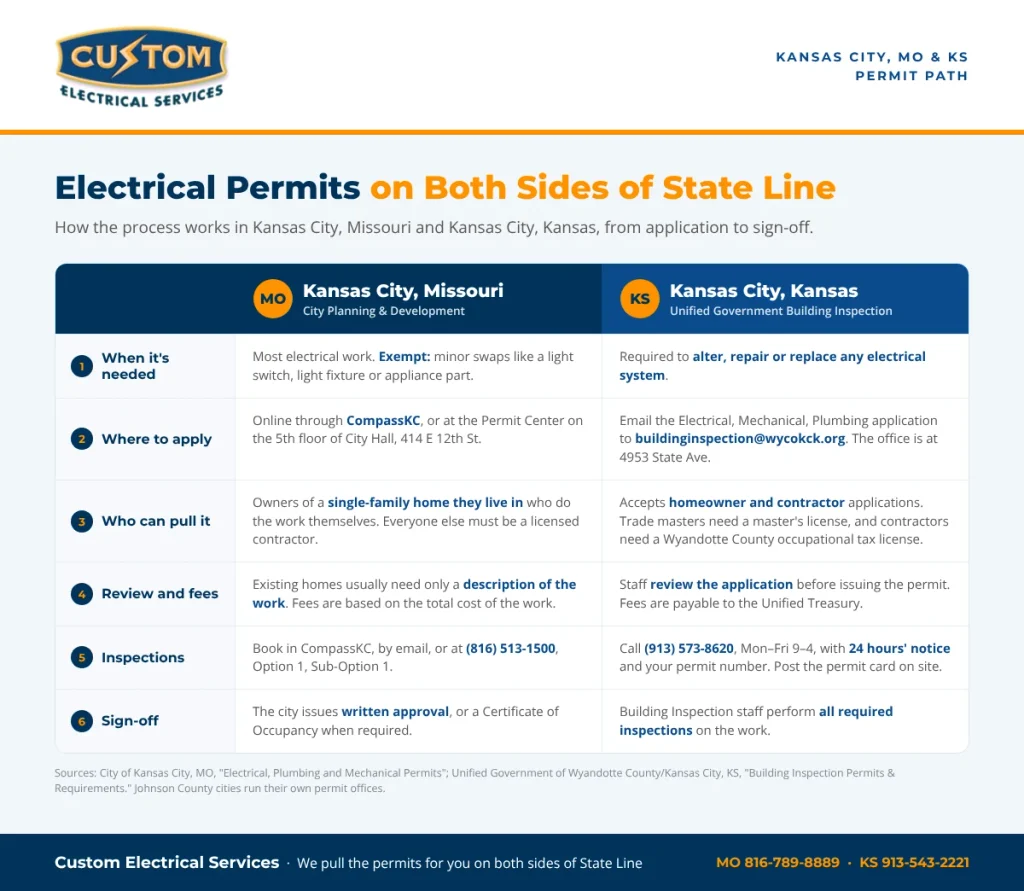
Step-by-step path for an electrical permit in Kansas City, Missouri, from assessing the work to final approval]
Schedule a Wiring Quote with Our Kansas City Electricians
Custom Electrical Services has been family-owned and operated since 2005, and we now serve homeowners across both sides of the Kansas City metro. Our Kansas City electricians handle everything from inspections and aluminum wiring replacement to full rewires, with upfront pricing before any work starts.
Call 816-789-8889 in Missouri or 913-543-2221 in Kansas to speak with an electrician in minutes.
Answers to Frequently Asked Questions On Kansas City Wiring
Can I buy a Kansas City home featuring knob-and-tube wiring?
Yes. Many older homes in the area still have some. Before closing, have a licensed electrician estimate how much is active and what it would cost to replace, and check with your insurance company early. Some insurers limit coverage or require an inspection for homes with knob-and-tube.
How long does a whole-home rewire take?
Most single-family rewires take several days to a couple of weeks, depending on the home’s size, layout, and access. Electricians typically fish new wire through walls with small access openings rather than removing full sections of drywall, and you can often stay in the home during the work.
Can I add more outlets instead of rewiring?
Adding outlets to an overloaded or ungrounded circuit spreads the same problem around. New outlets should go on circuits that can handle the load, which sometimes means running a new circuit from the panel.
Are two-prong outlets against code?
Existing two-prong outlets are generally allowed to stay. When replacing an outlet, the National Electrical Code allows a few options: another two-prong outlet, a GFCI outlet labeled “No Equipment Ground,” or a three-prong outlet that is either properly grounded or GFCI-protected and labeled. Simply swapping in a three-prong outlet without a ground or GFCI protection isn’t one of them.
How often should I have my home’s wiring inspected?
Have it inspected when you buy a home, before a major renovation, and any time you notice warning signs. Homes more than 40 years old benefit from a periodic check even when nothing seems wrong.
Can one electrician work on both the Missouri and Kansas sides of the metro?
Only if they hold the required credentials for each jurisdiction. Licensing isn’t automatically shared between the two states, so ask any contractor whether they’re licensed where your home is located.